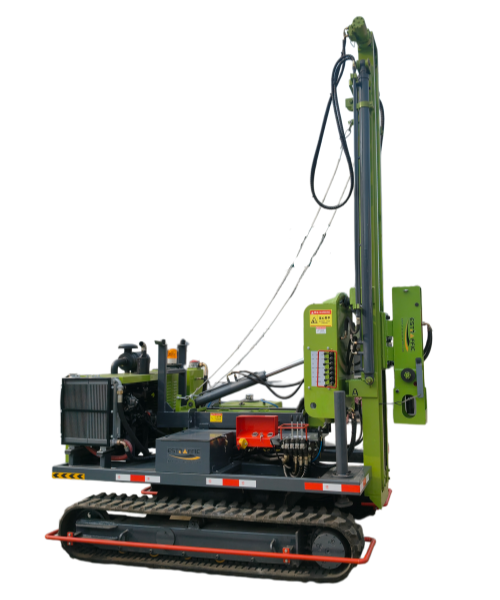
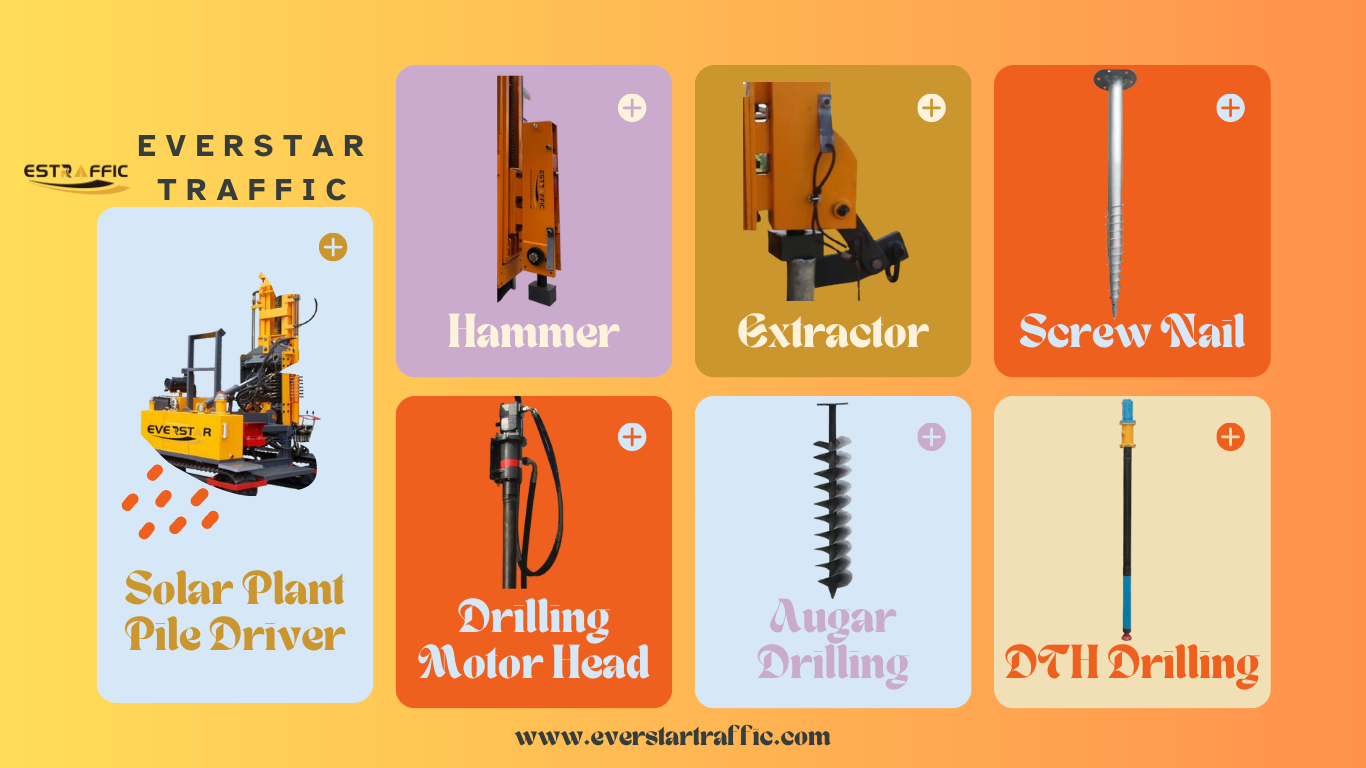
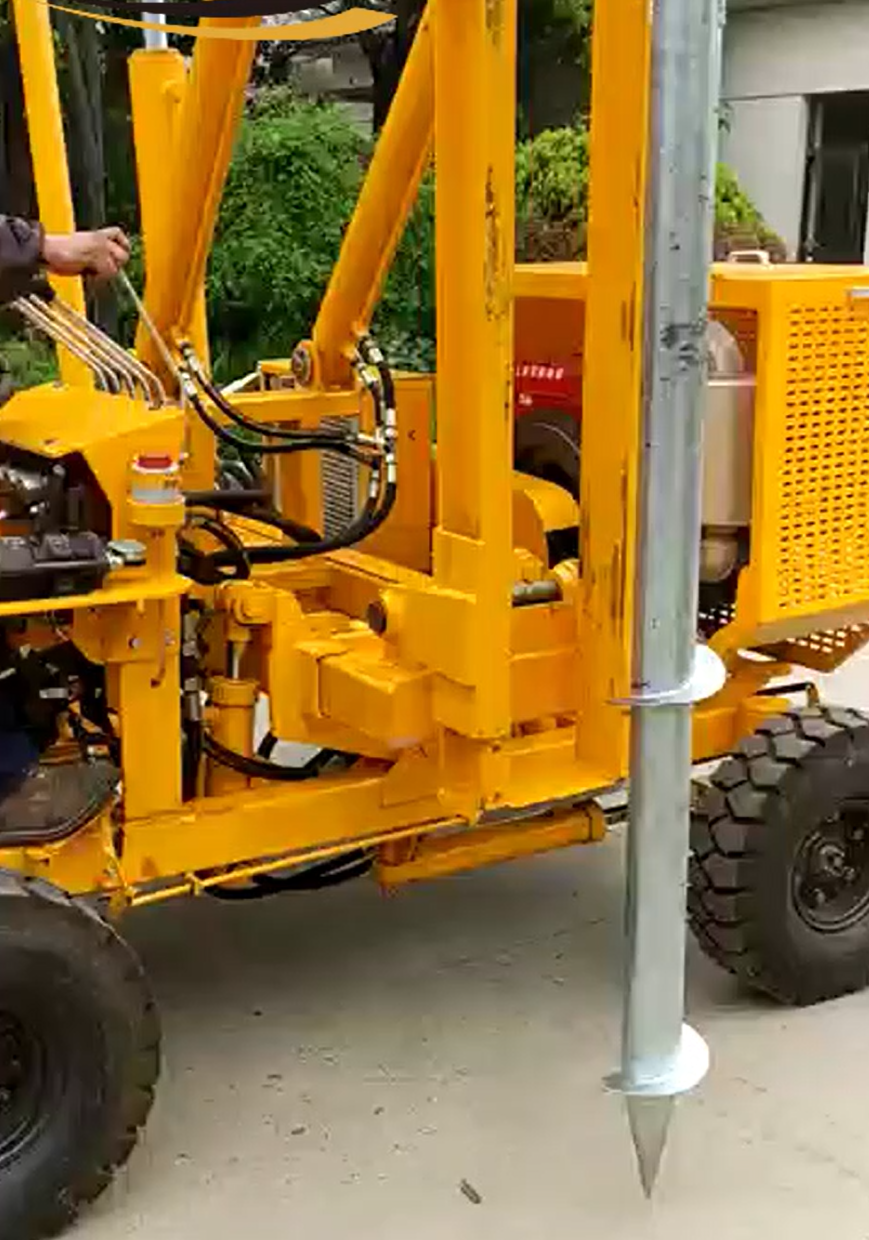
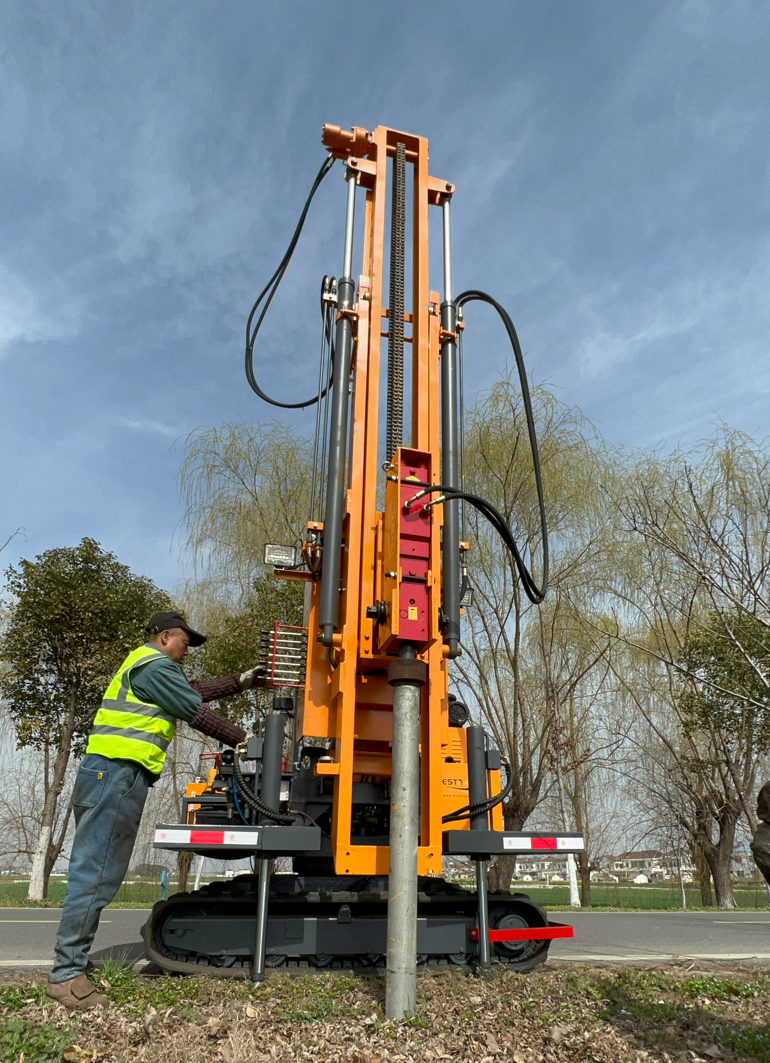
A solar plant pile driving machine (or solar pile driver) is a specialized, often crawler-mounted machine, used to install the deep foundation piles for ground-mounted solar farms. Its primary job is to drive steel posts (piles), vertical steel piles, posts, or ground screws several feet into the ground to serve as the structural anchor for solar panel tracking systems and tables.
It uses hydraulic, pneumatic, or vibratory force to drive supports into the ground, ensuring stability for utility-scale solar farms.
Working Theory
The equipment uses a hydraulic system to drive a hammer or vibratory device to implant piles;
The core principle is to use impact force or vibration energy to overcome soil resistance and stabilize the pile foundation;
High-frequency vibration is used to press the pile into the ground, which is suitable for sandy or loose soil.
Components of Solar Plant Pile Driving Machine
A typical photovoltaic piling machine mainly includes:
Power system: Provides power, which can be an electric motor, diesel engine, or internal combustion engine.
Drive unit: Drives the hammer.
Lifting device: Controls the vertical movement of the drill rod.
Frame and traveling mechanism: Supports the entire machine and enables movement; tracked types are commonly used to enhance mobility.
The most significant trend in this equipment right now is automation. The industry is rapidly moving away from purely manual operation toward semi-autonomous, fully autonomous systems and GPS-guided, to address labor shortages and improve speed.
Current Popular Categories of Solar Plant Pile Driving Machine
Semi-Autonomous Systems:
These are remotely operated machines enhanced with 360°rotational chassis. The hydraulic system automatically remotely controls the machine position. The machine mast, operation joysticks, walking crawler er are driven by hydraulic system. Crew reduction: Allows 1 operator to do the work of 2-3 people .
Fully- autonomous systems:
These systems convert standard excavators into fully autonomous robots. They can carry their own supply of piles, operate 24/7 without a human in the cab, and use sensors to detect obstacles. Two robots often work in tandem—one positions the pile, the other drives it. Throughput: Can achieve 2.5x the weekly output of manual methods .
GPS-guided:
Instead of driving (hammering) piles, this type automates the drilling/screwing process for helical foundations. It is particularly useful for rocky or sloped terrain where driven piles struggle .
Key Features and Functions:
Efficiency: Designed for high-speed, accurate installation of vertical supports, significantly faster than traditional manual methods.
Mobility & Design: Usually mounted on crawler tracks to navigate uneven terrain and compact enough to move between rows of solar panels.
Versatility: Capable of handling various pile types, including C-sections, H-sections, pipes, and screw piles, adjusting for soil conditions like hard ground or soft, rocky soil.
Components: Typically features an independent hydraulic system, a mast for positioning, and a hydraulic hammer or vibrating head to drive the piles.
Automation: Some models include automatic pile positioning systems to increase accuracy and reduce installation errors.
These machines are essential for constructing ground-mounted photovoltaic power stations, ensuring the racking systems can withstand environmental forces.